
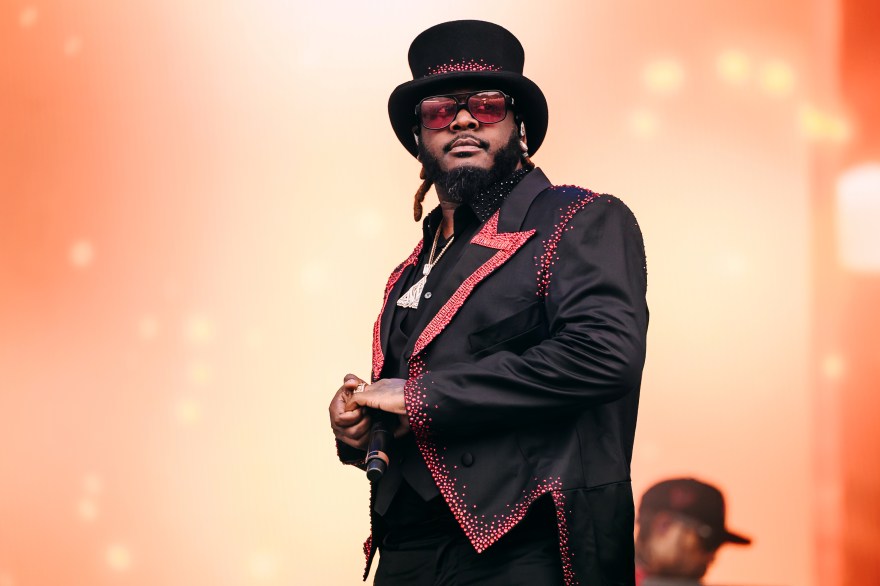
Nearly 20 years removed from the Auto-Tune revolution he helped spark, T-Pain says the most important lesson he’s learned behind the boards have nothing to do with vocal presets.
Videos by According2HipHop
Sitting across from Shannon Sharpe on a recent episode of Club Shay Shay, the Tallahassee legend peeled back the curtain on over two decades of hard-earned clarity about trust, loyalty, and the fine print of friendship in the music industry. The conversation was meant to celebrate the anniversary of his debut Rappa Ternt Sanga, but it quickly turned into something more revealing.
“Nobody is your brother. Nobody,” he told Sharpe, cutting through the platitudes that often float around studio sessions. “Everybody’s your brother while they can use you. That is the quickest and most consistent thing that I’ve learned through this whole thing.”
One of the examples he brought up (though he made clear it wasn’t personal) was DJ Khaled, a figure he once shared chart-topping chemistry with. Their run together in the late 2000s gave hip-hop some of its most enduring anthems: “All I Do Is Win,” “I’m So Hood,” “Go Hard.” But as the industry shifted and new alliances formed, so did their dynamic.
“I’ve had f—king DJ Khaled, and everybody tell me, ‘I’m your brother.’ Do not believe that s—t!,” T-Pain said. “And then none of that s**t was reciprocated.”
Their relationship famously cooled around 2013 when Khaled began working more closely with Future, a transition T-Pain once interpreted as being replaced. But on Club Shay Shay, he stressed that Khaled wasn’t the point so much as an emblem of a larger pattern he’s witnessed over the course of his career.
“It’s not a DJ Khaled thing… that’s just the first person I thought of,” he clarified. “I’ve seen this dynamic across the board.”
When a clip from the interview made its way online, fans were quick to mishear T-Pain’s rapid-fire delivery and assume he’d said “f**k DJ Khaled.” He jumped onto Instagram to set the record straight in quintessential T-Pain fashion.
“Well I definitely didn’t say f—k DJ Khaled,” he wrote. “I’m from Florida, and n—as apparently can’t understand how fast I talk. I said ‘f—cking DJ Khaled…’ because I was about to start a list, but decided it’s still love. I just learned how to move around n—as now.”
That sense of adaptation — of learning the room, learning the game, learning the difference between brotherhood and business — was a central theme throughout the entire conversation. T-Pain didn’t sound bitter so much as seasoned, determined to protect his peace the same way he once protected his sound.
“When people tell you how much you mean to them, don’t grab onto that,” he said. “When they tell you what they can mean to you in return, that’s what you gravitate toward.”
Twenty years into a career that reshaped modern music, T-Pain is reminding both veterans and newcomers what the industry rarely says out loud: talent can open doors, but survival comes from knowing who’s on the other side, and why they’re really knocking.